Sixth CPC Report:(iv) Pvt. Vs. Govt. Sector

There have been varied responses from the Government employees to the Report of the Sixth Central Pay Commission. There are very few reactions which express satisfaction. Majority of the employees all over the country seem to be unhappy with the recommendations and have termed the recommendations as insensitive and insufficient to their needs. The frustration seems to stem from the fact that the expectation of getting salaries “at par with the private sector “ have not been met as per their interpretation of the Report. What has been overlooked is that the Commission has made sincere efforts to meet this expectation. It has tried to balance the demand with the mandate given to it for transforming the Government workforce into a modern and efficient organization.  

The Commission Report says that it has attempted an in-depth study into working of the private sector and noted that the compensation structure in the private sector is quite different as compared to Government sector. Since the establishments in private sector primarily work for commercial purposes the employee‘s cost is compared to the business worth. Such comparison is not feasible in Government jobs obviously for the reason that the Government sector is primarily service oriented. Also the variation in range of salaries in private sector  is quite wide .

On comparison with Government sector it noted that the salaries can be said to be definitely better in private sector only in reference to jobs which can be compared to Group A services . However in that respect the prestige and challenge offered by the Government jobs is also quite high and the Government jobs also provide incentives by way of compensatory allowances, housing and transport facilities etc.. The biggest advantage offered by a Government job is the job security attached to it and the assured retirement benefits. Commission has attempted to make the retirement benefits more attractive.  It has thus attempted to harmonize the tangible and intangible benefits offered by the two sectors for achieving some element of parity. 

For tackling the demand of the Government employees for making the minimum salary in the range of Rs. 10000/- per month the Commission has followed a multi pronged approach. Firstly it worked out the minimum monthly requirements for the family of lowest paid employee It has based it’s calculations keeping in view recommendations of the 15th International Labour Conference . The expenses when calculated on a family size of three units which is the expected family size for a job entrant came out in range of Rs.5500/-per month.   
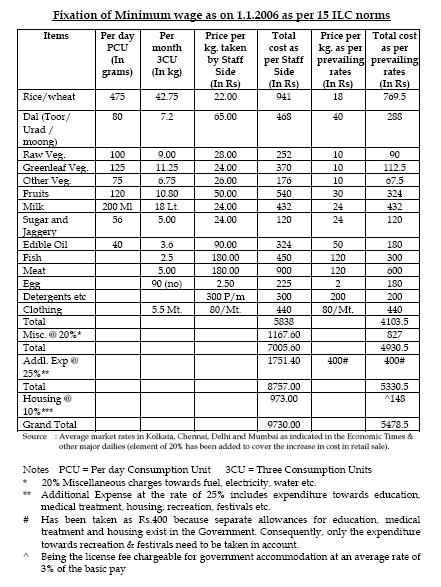
minimum-expenses.jpg

          (Source: table 2.2.1 Pg.53 Chapter 2 of Sixth CPC Report)

Thereafter the pay scales were fine tuned to make the minimum salary in the range of Rs. 6600/- in order to make the same approximate to the minimum needs of the lowest paid employees. Commission feels that the addition of HRA and other allowances would make it some where in range of Rs.10000/- as was demanded.  

However simultaneously it also had to ensure that the relief is not considered as a windfall gain for the employees. It has therefore suggested transformation of the lowest paid employees into multiskilled workers whose skill levels could justify the higher wages. The Commission has therefore recommended that the Group D employees be converted to Group C employees in those cases where they fulfill the qualifications prescribed for Group C posts.

This would ensure that they not only get higher wages but also handle higher responsibilities. The employees who do not possess the minimum qualifications should be trained for skill up gradation and subsequent transition to Group C posts. Recruitment to Group C posts is proposed to be stopped forthwith. 

Next post: Estimation of benefits in real terms

Report of Sixth Pay Commission:who gets what

The Sixth Central Pay Commission (CPC) Report was out in the afternoon and simultaneously the work force in sarkari establishments went into jubilation. Calculators were brought out and the humble pay clerk in the office became the most sought after person to facilitate estimation of how much bucks would flow in whose kitty. Euphoria of this kind is a regular occurrence after announcement of pay benefits but is short-lived till the actual calculations are made. The rapid rise in market prices and also the amazing growth of salaries in private sector soon overtake the government pay scales.  

On this  occasion the media is all agog with the overestimated projections of benefits and for days together it goes on repeating the imagined negative impact on the national economy. The media forgets the fact that journalists also look forward for wage increase and as compared to the increase in every other sector the Government servants get a modest jump in pay every ten years . It is also forgotten that the economic impact on budget which is sought to be over hyped is the  only decadal benefit offered to millions of families of government servants who are also fellow countrymen and have a right to share the national wealth.  

A quick glance at the report and projected pay scales (now referred to as pay bands) shows that on an average a government servant would get additional financial benefits which would be in the range of 40% of the existing basic pay. Even the top salaries of Secretary in Govt. of India and Cabinet Secretary which appear to be quite high in real terms are likely to increase  to that extent only. 

The real indicators of improvements in working conditions as reflected in the report of the Pay Commission  are the measures suggested to take care of female employees, group D employees, physically challenged employees and the pensioners. The Commission has also suggested improvements in the allowance and compensation packages for army men. For healthcare it has proposed Health Insurance Schemes at places where CGHS facilities are not available. 

For the women employees the facility of maternity leave is extended to six months against existing three months and concept of flexible working hours has also been brought in. The suggestions if accepted would certainly be considered as a very progressive gesture on part of a caring employer. 

In respect of the lowest paid employees presently classified as Group D employees the Commission has suggested their upward mobility to Group C in case they fulfill the educational qualifications . Those who do not possess the requisite qualifications are proposed to be trained to rise to Group C in due course of time. The Commission seeks to transform them into multi skilled persons. Attention of this nature  on workforce on the lowest rung of ladder was also  long overdue.  

For the physically challenged employees the concept of flexible working hours has been introduced. The Commission has also proposed measures which would facilitate their access to good quality aids and appliance which would help them overcome the respective disabilities in a better manner. Other benefits which have been proposed are higher rate of transport allowance and subsidy in the loan for purchase of car @ 4%. 

Retiring Govt. employees can now expect a higher quantum of gratuity (an amount equal to 15 Months emoluments at the retirement stage). The ceiling of Rs. 3.5 Lakhs has been proposed to be raised to Rs. 10 Lakhs. Another innovative measure suggested for helping the retired employees is increase in pension at various stages between 80 to 100 years of age. It is proposed to increase the benefit @ 20% for 80 year olds and thereafter @ 20% for each slot of subsequent 5 years. This has been justified on grounds of increased expenses on medical facilities in old age and is a very well thought gesture. 

For improving the morale of army men additional compensation in case of casualty has been proposed. The Commission has also suggested additional pay for those in line of service. 

As a part of system improvement the daily allowance for officers on tour has been made more realistic so that the govt servants on duty can stay in comfort. Officers availing LTC have been permitted air travel if they are entitled for the same for official tours. Leave encashment procedure for LTC has also been liberalized. 

The major indicator of structural reforms made by the Commission is reduction in  the number of pay scales . The Commission has also introduced the concept of pay band by clubbing  a number of scales into a long running scale with grade pay as mark of identification of seniority. The Commission expects to iron out several anomalies by introduction of this concept. Another new concept introduced by Commission is concept of differential increment rate based on performance. Unlike other measures this suggestion may not be met with enthusiasm since performance appraisal in public services is still a grey area which is not yet truly modernized.