Sixth CPC Report: (iii) Concepts of Pay Band, Grade Pay , Performance Linked Incetives

The Sixth Pay Commission has brought about certain significant changes in the pay fixation methodology. The newly introduced concepts are (i) Running Pay Bands (ii) Grade Pay (iii) Performance linked incentives.  The concept of running pay bands although familiar to Armed Forces is proposed for the first time in respect of civilian employees. Running Pay bands were earlier recommended for Armed forces by Fourth CPC but were again replaced with regular scales by Fifth CPC. The Commission has attempted simplification of pay structure by reducing the number of pay grades to 20 against the prevailing 39 scales.

These reduced numer of pay scales (now referred as grades) have been clubbed together to form several distinct pay bands named as -1S,PB-1,2,3,4.    Pay band –1S (Rs. 4400/–7400/-) corresponds to Group D scales marked as S-1 to S-3 by the Fifth CPC . The Commission has recommended gradual absorption of such employees in Group C posts and also recommended that no further recruitments be made in this scale of pay. The Scale would thus be phased out with passage of time. It has 3 grade pays in it’s span. 

The next Pay Band PB-1 (Rs.4860/- -20200/-) covers the Group C Scales which were classified  by fifth CPC as S-4 to S-8. PB-1 has 5 distinct pay grades within it. 

 PB-2 (Rs.8700/–34800/-) covers the Gr. B employees ( S-9 to S-15 Scales of Fifth CPC).  It includes 4  pay grades within it.
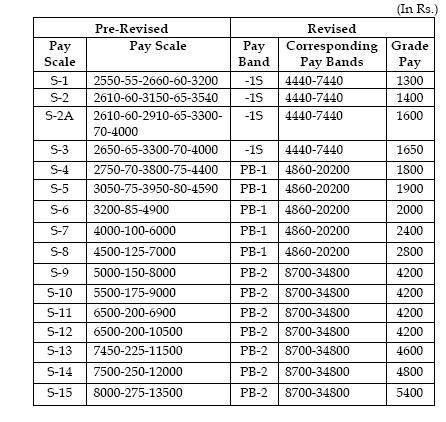
table1.jpg

 PB-3 (15600/–391000/-) is the Pay Band corresponding to Group A services and has  a total span of 32 years. The old scales covered by the Band are S-16 to S-27. It has total of 8 grades embedded in it’s span. 

PB-4 (Rs.39200/–67000/) corresponding to Super time Scale covers S-28 to S-32 Scales of Fifth CPC and has 3 distinct grade pays corresponding to various stages of movement of the employee. 
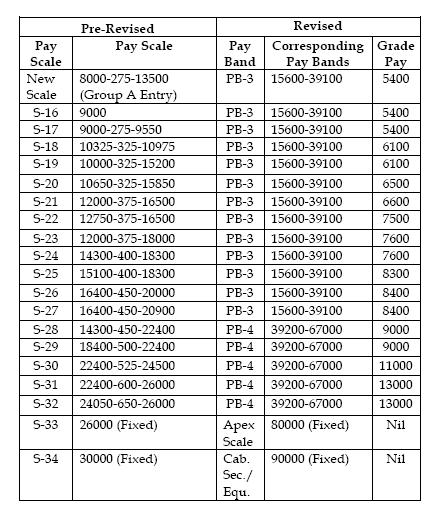
table-2.jpg

Apex Scale (Rs.80000/-) corresponds to erstwhile scale of S-33 which is the pay Scale designated for officers of the rank of Secretary Govt. of India. The Cabinet Secretary’s Scale (Rs. 90000/-) corresponds to S-34 Scale of Fifth CPC. 

The Commission expects that the concept would lead to elimination of hierarchies and weed out several pay scales which had lost relevance. The concept of a continuous pay band would obviate anomalies which are generated at the various stages of pay fixation . It would also prevent stagnation in those cases where an employee has reached the maximum of his pay scale. It has been pointed out that when the recommendations of the Fifth CPC were implemented several employees reached the maxima of respective pay scales immeadiately. such a situation is required to be averted. In the proposed system any officer reaching maximum of Pay Band would be automatically rolled over to next Pay Band subject to the condition that the original grade pay would not change unless the official is formally promoted to higher Pay Band.   The Commission has tried to maintain the increase in scales to the approximation of 74% which is the % increase of DA which was admissible on 1/1/06 in the pay scales of Fifth CPC. 

Concept of Grade Pay:-In order provide fitment benefits in the new pay scales and also to provide for a hierarchy based structure for the various Pay bands the Commission has introduced the concept of grade pay. The grade pay for various stages have been fixed on basis of the span of original pay scale covered as well as the nature of the Fifth CPC  pay scale of the beneficiary. The grade pay has been fixed in the range of 40% of the maximum of the pre revised scales (of Fifth CPC). It would change in course of time when a promotion takes place within the pay band or to the next pay band. It would also help in earmarking posts against different grades depending on the job requirement. The Grade Pay would also be taken as part of the pay for calculation of allowances including DA. 

Performance linked Incentive Scheme have been conceived for PB-3 which covers the group A Services . The scheme suggests a higher rate of increment (3.5%) for good performers against standard rate of 2.5% per annum. It has been suggested that not more than 20% officers in a cadre should be covered with the higher increment category. The Commission considers this to be an innovative measure for promoting efficiency in Services. 

Other innovations : The Commission has maintained a ratio of 1:12 in the minimum to maximum salary. It has also suggested that henceforth all increments be released on 1st of July. 

Sixth CPC Report:(ii) Benefits for All India Services

Chapter 3.2 of the Report deals with All India Services. The three All India Services namely Indian Administrative Service (IAS) , Indian Police Service (IPS) and Indian Forest Service (IFS) owe their origin to the mandate given to the Parliament under Article 312 of the Constitution. The recruitments for IAS & IPS are made by UPSC based on competitive examinations held annually. The Recruitment for IFS is made through separate All India Examination. The Commission’s report has given due appreciation to the importance of All India Services and observed that innovative measures are necessary for ensuring that these services are able to deliver to the best possible extent.

The Commission has observed that the supremacy of IAS over the other All India Services has to continue as per the trend which started from the times when the First Central Pay Commission submitted it’s report. It has noted that the Fifth CPC had also held the same views in this context. While coming to this conclusion it has taken note of the wide ranging exposure to challenging assignments that the officers of this service experience over their career.

Regarding the competition with private sector salaries the Commission’s observations are that despite the difference in pay package the IAS due to it’s unique status in the scheme of governance continues to draw the best talents. A large number of young men and women who join the service are professionally qualified and have in many cases given up economically rewarding jobs to join IAS because of the challenges and prestige attached to the service. The IAS officers have been given an edge in the pay scales at the entry stage in view of the tough and challenging atmosphere that they have to encounter from the initial stage of service. The edge given by the Fifth CPC in different pay scales had in monetary terms ranged from Rs.650/- to Rs.800/-. In the recommendations for the Sixth CPC the grade pays recommended for IAS have been made slightly higher in comparison to grade pay for other services by Rs.400/- for Senior Time Scale, Rs. 900/- for Junior Administrative Grade and Rs. 700/- for NFSG (Non functional Selection Grade). The benefit would continue throughout their career due to proposed nature of pay scales known as pay bands.

For the Indian Police Service a major recommendation is for up gradation of posts of Director Generals (DGs) in all the five Central Para Military Forces (CPMFs) to revised scale of Rs. 80000/-. The Commission feels that this step would ensure continuity in the Services and create an atmosphere conducive to planning for long term reforms in these forces . For the Indian Forest Service (IFS) up gradation of similar nature has been recommended for the Post of Director of Indira Gandhi National Forest Academy (IGNFA).

The most popular demand raised by the IPS was for removal of the post of DIG which is covered by Super Time Scale of Rs.16400/-.Commission noted that the post of DIG is a functional post in most of the States as well as in CPMFs. In several States the range is headed by DIG. It has recommended that the post be continued. The officers in the Forest Service had made a similar demand for the Post of Conservator of Forests. The demand has been found unacceptable on similar grounds. Commission has also recommended that the relative hierarchical structure recommended by the previous CPC should continue in the IFS.

Sixth CPC Report :(i) Dearness Allowance

The Sixth Central Pay Commission (CPC) has devoted fourth chapter of the report to the subject of Dearness Allowance (DA) payable to government servants. The sanction of Dearness Allowance is at present based on calculated six monthly increase in the All India Consumer Price Index (Industrial Workers) (AICPI-IW) with base year 1982=100. At the time when the scales granted by Fifth CPC came into existence (1st Jan.1996) this index stood at 306.03.

Fifth CPC started with calculation of DA @ 0% . from 1st Jan.1996 . In the month of April 2004 the rate at which DA was admissible had crossed the figure of 50% and therefore based on recommendations of the Fifth CPC 50% DA was merged in the basic pay . This addition to basic pay was known as Dearness Pay. .Thereafter every increase in DA was calculated on (Basic Pay + Dearness Pay). It has been observed that since after the merger of dearness pay with basic pay the base for calculation of increase in AICPI was not changed the neutralization in cost of living was presently being done at a rate higher than 100%.

Commission has pointed out that the present method of calculation for increase in cost of living takes into account the price rise in a group of identified commodities. It has compared the relative merits of “chain based” and “fixed base” methods of calculation of estimated growth in cost of living. The AICPI as stated above is based on the increase in cost of a basket of identified commodities. In the fixed base method the calculations are based on the assumption that consumer would adjust his consumption needs in relation to increase or decrease in prices of the constituent commodities. The chain based method takes into account the possibilities of change in consumption pattern due to availability of wider range of consumption goods and the improvement in the quality thereof due to economic growth. The latter methodology has been considered to be more relevant in today’s economic scenario.

However the basic data for the pattern of consumption in respect of several essential commodities would have to be compiled through a detailed all India survey if this methodology is to be adopted . The previous Pay Commissions had different views on this matter. The Fourth CPC favored evolution of a separate index for calculation of cost of living for the government servants. The Fifth CPC however felt that such index would also suffer from imbalances since consumption patterns of various categories of employees would be different. The Sixth CPC has suggested a sample survey through National Statistical Commission for evolving an index based on consumption pattern of government employees. Till this exercise is completed the present methodology of calculating the increase in cost of living and calculation of DA would continue.

Report of Sixth Pay Commission:who gets what

The Sixth Central Pay Commission (CPC) Report was out in the afternoon and simultaneously the work force in sarkari establishments went into jubilation. Calculators were brought out and the humble pay clerk in the office became the most sought after person to facilitate estimation of how much bucks would flow in whose kitty. Euphoria of this kind is a regular occurrence after announcement of pay benefits but is short-lived till the actual calculations are made. The rapid rise in market prices and also the amazing growth of salaries in private sector soon overtake the government pay scales.  

On this  occasion the media is all agog with the overestimated projections of benefits and for days together it goes on repeating the imagined negative impact on the national economy. The media forgets the fact that journalists also look forward for wage increase and as compared to the increase in every other sector the Government servants get a modest jump in pay every ten years . It is also forgotten that the economic impact on budget which is sought to be over hyped is the  only decadal benefit offered to millions of families of government servants who are also fellow countrymen and have a right to share the national wealth.  

A quick glance at the report and projected pay scales (now referred to as pay bands) shows that on an average a government servant would get additional financial benefits which would be in the range of 40% of the existing basic pay. Even the top salaries of Secretary in Govt. of India and Cabinet Secretary which appear to be quite high in real terms are likely to increase  to that extent only. 

The real indicators of improvements in working conditions as reflected in the report of the Pay Commission  are the measures suggested to take care of female employees, group D employees, physically challenged employees and the pensioners. The Commission has also suggested improvements in the allowance and compensation packages for army men. For healthcare it has proposed Health Insurance Schemes at places where CGHS facilities are not available. 

For the women employees the facility of maternity leave is extended to six months against existing three months and concept of flexible working hours has also been brought in. The suggestions if accepted would certainly be considered as a very progressive gesture on part of a caring employer. 

In respect of the lowest paid employees presently classified as Group D employees the Commission has suggested their upward mobility to Group C in case they fulfill the educational qualifications . Those who do not possess the requisite qualifications are proposed to be trained to rise to Group C in due course of time. The Commission seeks to transform them into multi skilled persons. Attention of this nature  on workforce on the lowest rung of ladder was also  long overdue.  

For the physically challenged employees the concept of flexible working hours has been introduced. The Commission has also proposed measures which would facilitate their access to good quality aids and appliance which would help them overcome the respective disabilities in a better manner. Other benefits which have been proposed are higher rate of transport allowance and subsidy in the loan for purchase of car @ 4%. 

Retiring Govt. employees can now expect a higher quantum of gratuity (an amount equal to 15 Months emoluments at the retirement stage). The ceiling of Rs. 3.5 Lakhs has been proposed to be raised to Rs. 10 Lakhs. Another innovative measure suggested for helping the retired employees is increase in pension at various stages between 80 to 100 years of age. It is proposed to increase the benefit @ 20% for 80 year olds and thereafter @ 20% for each slot of subsequent 5 years. This has been justified on grounds of increased expenses on medical facilities in old age and is a very well thought gesture. 

For improving the morale of army men additional compensation in case of casualty has been proposed. The Commission has also suggested additional pay for those in line of service. 

As a part of system improvement the daily allowance for officers on tour has been made more realistic so that the govt servants on duty can stay in comfort. Officers availing LTC have been permitted air travel if they are entitled for the same for official tours. Leave encashment procedure for LTC has also been liberalized. 

The major indicator of structural reforms made by the Commission is reduction in  the number of pay scales . The Commission has also introduced the concept of pay band by clubbing  a number of scales into a long running scale with grade pay as mark of identification of seniority. The Commission expects to iron out several anomalies by introduction of this concept. Another new concept introduced by Commission is concept of differential increment rate based on performance. Unlike other measures this suggestion may not be met with enthusiasm since performance appraisal in public services is still a grey area which is not yet truly modernized.

Goa Tourism: Return of the Bikini Killer

Goa Tourism is again in news for wrong reasons. The violation and murder of a child of British  origin has  reopened  a host of issues on sustainable development of tourism sector specially in that small state.  NDTV  hosted a panel discussion  under screaming headlines  “Whether  Goa’s underbelly is exposed ?” . Despite of the fiery oratory of TV anchor  and some mini fire works from local  intellectuals during the discussion, the core issues were still left wide open.  

Goan beaches have for long offered attraction not only to the newly weds , courting couples as well as   lovers in suicide pact but also to criminals of various origins and tastes. Mention of crime on beaches brings   back memories of Bikni Killer days of mid seventies when a compulsive murderer Chalres Shobhraj  due to his serial killing  of unsuspecting tourists on Goan beaches had become an international icon in the crime world.  

 The NDTV panel discussion surprisingly included Ms. Bina Ramani whose involvement in covering up the famous Jessica Lal murder case was  topic of similar fiery discussions  quite recently . Her inclusion as opinion giver also highlighted the fact that the memory of our media is rather short and issues are dealt with rather superficially. More so because at the time when Bina Ramani was arrested at Goa , the local press was quick to condemn her along with all those so called dubious persons of her kind  who settle at Goa in the name of business. 

The queen of ceremony during the discussions was the mother of the murdered child seated in the centre and given the privilege of firing indiscriminately at all and sundry. The lady who boasts of eight children sired by her four male companions, innocently pleaded that the fourteen year child was not a drug addict but occasionally indulged into intake of marijuana. The lady it seems has all of a sudden developed  a very dim view of Goa Police and has been threatening to blow the lid off certain drug running racket but has apparently not done any thing in that direction so far.  T

he debate as always veers around  the issue as to how safe are the Goan beaches. A plump local politician boasted that he feels safe even while roaming around the midnight without any security guards. The funny statement was reflective of mind set of ruling Goan politicians and their  inability to appreciate humanitarian issues. Who would molest or assault a person of his bearing? Or whether he could be the target of harassment or cause of fear  for someone while roaming around the streets at midnight ? This  single comment thus  also gave some hint about  the real suspects in the game. 

The fact that on the very next day a female tourist faced sexual harassment in Pushkar and subsequently complaints popped up from Russian tourists at Mumbai regarding similar difficulties, indicated that the crisis is not confined to Goa alone. Fairly well known  incidents of ruthless killing involving persons of decent  origin like Shivani Bhatnagar , Jessical Lal and Nitish Katara  by well connected goons in and around Delhi and the case in which a Swiss diplomat suffered abduction and assault in broad daylight  coupled with the fact that the culprits are yet to be punished underlines the conclusion that such questions can be raised about the National Capital also. The long drawn series of murders of young children at Nithari and abduction and release of the child of an executive in a multinational at Noida bear testimony to the standards of safety of human life in adjoining areas. Clearly enough the underbelly Is exposed at a number of other places too. Then why single out Goa? 

The reason for this concern is that in Goa there has been an unprecedented deterioration in quality of life due to unabated influx of  semi clad, back pack  tourists. Who are these people and what is their special interest in Goa ? Where are they rushing in half naked conditions on motorcycles and scooters.  Certainly enough it is not only the Sun and Sand which draw more than two million tourists to Goa. Is it not that the benign attitude of upholders of law  and their unwillingness or inability to venture out in the field acts as a catalyst for facilitating inflow of tourists with  business interests of dubious kind. And could a system of such unprofessional standards have survived if the political patronage was not available ?  These are some questions which the Goan society would have to address to itself if it wants to reinvent the paradise that Goa was in the past. 

Jab Jodhaa met Akbar

In every civilized society which cares for individual sentiments there is some law for protection of certain heritage sites and buildings since these are considered to be the collective property of the humanity and there is a recognition of the fact that every one has a right to share the unspoilt beauty of an architectural monument or a natural formation in an unaltered fashion. Unfortunately there is no legal protection in respect of an icon of history whose image cultivated over generations is mercilessly butchered by a buccaneering film producer unrepentantly and with the simple excuse that it is merely a work of fantasy and has no historical basis!

Aushutosh Gowrikar of Lagaan fame has done precisely that to the image of Jodha Bai a Rajput Queen of middle ages and the Mughal King Akbar who is remembered as one of the few benevolent despots who have given this country a symbol of administrative reforms and spirit of religious tolerance .

Having failed to meet success at the oscar nominations for his period film Lagan , Gowrikar has come out with a more calculated assault on the Oscar battlefield through Jodah Akbar romance which the film claims is not reported in history ( the name of the princess and her relation ship with Akbar is also doubted) but the expensive film with lavish squandering on objects of visual pleasure appears to be attempting to become a historical magnum opus. Nobody wishes to join the issue of historical credibility with Mr. Gowrikar but pray Mr. Gowrikar why did you thrust this plastic beauty of Indian screen to wipe out the memories of Jodha Bai so powerfully projected by the legendary Durga Khote. And your Akbar…although young , but can he ever be expected to adorn the throne occupied by powerful personae of Prithviraj Kapoor in Mughal-e-Azam which is etched in the memory of generations of cinegoers .

A good documentary for Rajasthan Tourism or chalu stuff for a good tear jerker TV serial to be watched by Saas Bahus in the afternoon , or a modern presentation of Vikram Betal stories is what you have produced Mr. Gowrikar with so much fanfare. Your bundle of mini stories of religious hysteria , Saas bahu tussle ,wimpish Rajpoot princes , plotting brother-in-law, fanatic ulemas and incognito visits of young emperor to see the status of his praja could have created a long running TV serial because each episode is a mini thriller but not the part of a story of any interesting substance. The only tears which come to the eyes of an intelligent cinegoer are due to strain of spending 200 minutes in the theatre for witnessing your mediocrity.

And there was a feeling of relief after coming out of the hall for one more reason. That was for the realization that the romantic excitement of Madhubala, Dilip Kumar pair in Mughl-e-Azam would remain beyond the reach of producers for all times and the movie would remain the true Moughal amongst the movies as tribute to the genius of it’s producer and Director.

Madam Ashwarya Rai may now try her luck with some other fake piece of history because this one again seems to have floundered like remake of Umrao Jaan…despite the hidden support of dad-in-law by way of unworthy praise of a dance sequence filmed on Hrithik Roshan. Cinegoers having seen the Mughal movies like Anarkali and Mughal-e-Azam will have to recall the emotional thrill of “Pyar kiya to darna kya “ dance number performed so tantalizingly by Madubala and the Quawalis of the films produced in sixties when they want to think of a piece of art which is highly entertaining and also intellectually satisfying , while the likes of Aishwarya and Aushotosh will fade away from the scene in no time.

And now last but not the least, the latest news  reports say that Mayawati Ji Chief Minister of Uttar Pradesh has chosen this occasion to garner some votes from Rajput community by placing a ban on the movie (just two days after the MP High Court quashed a ban of similar nature and under full realization that hers would also be a short lived ban). The scenario is a bit  comical in the sense that Akbar the great warrior of middle ages has come to the rescue of another damsel in distress in modern times by helping her recover some popularity in Rajput community .

A Goodbye to Appu

When Delhi hosted the Asian Games in 1982 the mascot of the Games a baby elephant named Appu stayed back in Delhi to become a symbol of unending fun in form of the amusement park known as Appu Ghar. The mascot in form of a dancing elephant adorning the gateway to Appu Ghar provided a cheerful day of fun and frolic during 25 years of it’s existence to millions of children. Located in heart of the town and offering so many permutations and combination of joy rides and games it was a place you could head for any time on any day . Weekend outings came to acquire a special meaning specially for the middle class crowds which could have free run of the place at an affordable cost. A whole generation of Delhites grew up with the joy and thrill of the rides and games. Other options to the city’s entertainment package by way of water parks or the occassional visiting circuses or the Delhi Zoo remained way behind in the matter of popularity.

Now Appu has grown weak standing on one leg for so many years and a new world is emerging around it which is more professional and devoted to matters of corporate concern, so Appu bids good bye to Delhi and to those whose child hood memories would never be complete without recalling the excitement and thrill of Appu rides. In the age of computer games and multiplexes Appu the symbol of common man’s entertainment will perhaps move to some smaller town where child’s world is still not trampled upon by monstrous organs of modern society . Delhi richer by achievements of scientific progress and by growth of legal wisdom through the library which will take place of joy rides now has less time to care for the smile of the young child.

Sanju baba in trouble again

Marriages are said to be made in heaven but an act of indiscretion or shall we say an unfortunate slip in compliance with law has lead to unmaking of a marriage of two stars of the earth. The much hyped marriage between Sanjay Dutt and his friend now known as Manyata (meaning recognition) appears to be unrecognizable as per law of the land. It has been discovered that the stars submitted false evidence in support of their proof of residence in Goa and thus the registration of the marriage is held up by the Registrar of marriages. The Govt functionaries who facilitated the submission of false certificates are facing disciplinary action for facilitating the an act of forgery.

It is not known as to what prompted the two film personalities to decide to get married at Goa . Perhaps Sanjay being ignorant of legal impediments and encouraged by some over enthusiastic goan lawyer friend unwittingly allowed himself to be caught in a legal wrangle of his own making. Having just temporarily managed to extricate himself from imprisonment in a criminal case relating to possession of unlicensed AK-47 gun and then getting it destroyed to conceal the evidence, he seems to be heading for another troubled phase in life due to the latest development. To add to his trouble now an ex husband of his lady love who claims to be not properly delinked from his marriage to her is also sending signals from his prison cell about illegality of the whole show.

If the marriage was planned in Goa to make it a secret affair or to escape the demanding ex husband, the move seems to have badly misfired. Media would always be happy if a marriage goes on rocks in comparison to a case where it is over peacefully and away from media glare.

Moreover in our country we have different standards for compliance with law for different social categories. While a politician living in Delhi can claim to be a resident of Assam for facilitating induction in the Parliament, and another one can remain a member of Parliament despite persistent controversies surrounding her nationality , others must not tinker with law. Remember, Delhi Police accused of gross negligence and fabrication of evidence in the Jessica Lal murder case went all the way to Goa for arresting socialite Bina Ramani on charge of giving a false address in her ration card !

It is sad to see Sanju Baba , son of such respected parents finding himself in such embarrassing situation while trying to seek a settled lifestyle, but February 2008 seems to be the month of falling satellites, having gone out of orbit due to calculation errors , perhaps a watchful astrologer could have forewarned the two stars.

Marginalise and Kill : The Politics of Raj

Sare jahan Se accha Hindostan hamara. Hum Bulbulein hain iski yeh gulsitan hamara. ( Our loveable Hindustan is above all others in the world. We are it’s singing birds and this is our garden) . This is how poet Iqbal described India before independence and partition. After independence from the British Raj, the Indian Constitution framed by politicians brought up with such liberal and romantic ideas gave us a free nation which bestowed on all citizens unfettered rights to freely move and settle in any part of the country.

Encouraged by this liberal constitution and newly found freedom the post independence era brought about a great intermingling of it’s people . Our great cities at one time took pride in being labeled as cosmopolitan in nature or sometimes being called a mini India. The south Indian Idly Dosa cuisine found it’s way to each north Indian eating joint and south India in turn felt proud to have a “ Shere Punjab” Hotel in every nook and corner of major metro cities. The Kathak dancers of Lucknow performed to fully packed auditoriums in Goa and the Hindi Cinema anchored at Mumbai established as a million dollar industry with the participation of Kapoor Khandans of Punjab. Considered as the heman of his times actor Dharmendra fell to the charms of South Indian belle Hema Malini and Masoor Ali Khan Nawab of a princely State in Punjab found solace in marriage with an actress of Bengali origin.

But the happiness and enjoyment of the newly born nation in creating a multidimensional social fabric was short-lived. The political leadership which in post independent India found itself overwhelmed with the task of nation building and in turn felt threatened for survival due to lack of imaginative problem solving capabilities reinvented the politics of divide and rule . The desperation and frustration, infact painted the obnoxious agenda with much sinister colours . The agenda got upgraded to marginalize and kill.

The new trend of political one-upmanship is leading to an astonishingly grim scenario . Firstly it was a war between north and south later on we narrowed down our boundaries and developed hatred for natives of all states other than our state . Majority of states now have some grouse with the neighboring state. Process of free flow of human beings across the state borders is considered as an invasion for financial exploitation. Each state has it’s own database to explain as to how business men and jobseekers from other states are choking the sons of soil in their states. Migration is considered as an act of crime to enjoy hard earned economic benefits of the other state. With every passing day the boundaries are shrinking further , now it is a question of culture being confined to cities.

So while Mumbaikars may enjoy their New Yea’s eve in Goa but the north indian taxi driver who ferried them across the border for enjoyments may get mashed up by Shiv Sainiks on return for not belonging to Mumbai ! In not too distant future a railway train running from one end of the country to other end may carry only dead bodies of passengers at the last stop because people of each state (or city?) would attempt to eliminate those passengers who are aliens i.e. from other states or cities.

Who said that the Raj is dead it has emerged in a new avtar.

To seal or to deseal: Question that puzzles Delhi Govt

The Sheila Dixit Govt. in Delhi has at least one major institution building achievement to it’s credit. It introduced the concept of empowerment of Resident Welfare Associations (RWAs) in a big way through the Bhagidari Scheme launched by it. The word Bhagidari meant partnership and the concept intended to provide opportunity for sharing of responsibilities and power between the RWAs and the Govt. The Scheme visualized Govt. support and guidance for growth and networking of these institutions to facilitate experience sharing and capacity building. At the initial stage the scheme seemed to have achieved success and earned several prestigious awards for the so called new concept in governance. However ironically a strange twist of events started which became a perpetual cause for conflict between the Govt. and RWAs.

Some of the RWAs were already enlightened to the civic rights of their members and a larger number with the newly acquired sense of power woke up to the need of raising their voices against the Govt’s negligence in enforcing the provisions of Delhi’s Master Plan. Over the years a large number of residential areas in various colonies of Delhi have acquired commercial character leading to progressive deterioration in quality of life for those who continue to live in their residential properties which are getting surrounded by unauthorized commercial structures. When the Govt. machinery was found to be unwilling to change the scenario , the RWAs were forced to take recourse to litigation.

The dispute went up to the Apex Court and the Govt. had to repeatedly cut a sorry figure for it’s knee jerk reaction to the grim scenario. The RWAs which were creatures encouraged and empowered by the Sheila Dixit Govt. found themselves involved in a running battle with the same Govt. The continuous monitoring by the Apex Court and the pressure to catch all the violators irrespective of their status became so intense that even the Chief Minister and certain other bigwigs in her party were running for cover against notices received against their personal properties for violation of Master Plan of Delhi or building bye laws.

The Govt., from the initial stage was cowering under pressure from the law breakers but found itself helpless against people’s power. The stage managed scenes of street violence and a legally unsustainable piece of legislation could not bail it out . The Govt. was forced to mobilize all power of state to seal thousands of Commercial establishments which were functioning in violation of law.

The battle is a rather ironical conflict between the law makers and the law supporters . The process of sealing of properties has taken a heavy toll on personal reputations of several major operators in the field besides the progressive Chief Minister of Delhi who is otherwise a progressive and professional politician. At one stage Delhi was agog with rumors that the whole business was masterminded by the daughter of ruling family who was promoting several new Malls in the city and needed buyers willing to pay high prices. Similar insinuations later popped up against relatives of a key figure connected with judicial activism. The issue is still wide open . A large number of commercial establishments have closed and shifted to conforming areas and to Noida and Gurgaon. However thousands crores of rupees invested in the sealed properties remain blocked and a source of continuous pressure on city govt. to find a way out.

A recent news item says that the Govt. is coming out with a legislative solution. But the outcome of legislation in favour of desealing of offending constructions remains to be seen. For Sheila Dixit Govt. caught in the crossfire , seal or to deseal is the question that keeps it’s intellect puzzled.