Sixth CPC Report:(xv) Recommendations Central Paramilitary Forces

The  recommendations concerning Central Paramilitary Forces (CPMFs) are covered under Ministry of Home Affairs  in Chapter 7.19 of the Sixth CPC report .The CPMFs comprise of the following 7 outfits.

Assam Rifles which originated as Cachar Levy in 1835 is presently having more than 63000 personnel (46 Battalion) .The force working under operational Control of Army guards Indo Myanamar border .

The Border Security Force (157 battalions) has been deployed on international borders since 1965 and also in anti insurgency operations.

The Central Industrial Security Force (CISF)  created in 1969 has more than 1 Lakh personnel deployed for guarding Airports (54), PSU Establishments (269) and several Govt. Buildings (49) including North Block , Part of South Block and CGO complex. It also provides technical consultancy for security and related matters.

Central Reserve Police Force (CRPF) (201 Battalions) having replaced Crown Representative Police of pre independence era is the oldest CPMF. The personnel from this force are engaged in major anti insurgency/ terrorism / militancy related operations in the country.

Indo Tibetan Border Police (ITBP) assists in Disaster Management related work in Central & Western Himalayan Regions and also in providing security cover for Kailash Mansarovar Yatra.

National Security Guard (NSG)  tackles high risk security operations.The personnel are drawn from Army (as Special Action Group) and CPMFs (as Special Rangers Group). The NSG commandos provide security cover for VIPs and take charge of security on special occasions.  

Sashastra Sena Bal which started as Special Services Bureau (SSB) in 1963 is deployed along Indo Nepal & Bhutan border covering stretch of more than 1900 kms in 20 Districts.

The major demand from CPMFs for being given status of organized Group A Services has not been agreed to on the ground that these services do not fulfill the pre requisites for such declaration as fixed by MHA. In support of it’s recommendations  the Commission has pointed out that substantial number of posts in these forces including those in pay scale of 18400-22400 are filled up by drawing officers on deputation from IPS and also pointed out that many intermediate grades do not exist in the hierarchy of these organizations. The Sixth CPC has also reiterated it’s philosophy of avoiding creation of too many services.

Commission has also not agreed to creation of certain additional posts demanded by CPMFs for creating promotional avenues on the ground that there should also be functional justification for posts . It has  felt that the provision of ACPs and the system of Running Pay Bands would minimize the grievances of such nature.

On the positive side the Commission has recommended the merger of the post of Addl DIG with that of DIG (16400-200000) . It has recommend that all posts upto the rank of DIG and 50% posts in the grade of IG and equivalent should be filled by promotion from officers of CPMF.

The following pay structure has been recommended for non gazetted executive cadres of CPMFs.
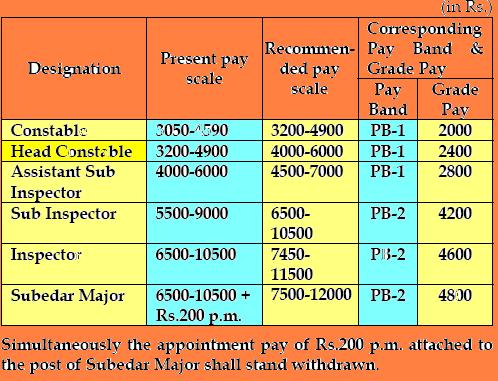
Commission has also noted that except for CISF all CPMFs are not filling up posts of ASI in the executive cadre .This step being contrary to order Dt.10/10/97 is affecting the structural parity within the forces . It has suggested that all CPMFs should continue the post of ASI since this is a functional necessity.

Other recommendations made by the Commission  include payment of ration money at par with Armed Forces to existing beneficiaries and doubling of the rates for Detachment Allowance (without linkage to DA) . Rates of Kit Maintenance Allowance are proposed to be doubled with increase of 25% after every hike up to 50% in DA. The rates of Uniform Grant are recommended as Rs.13000/-(initial) and Rs.6000/- (renewal-every 3 yrs).

For taking care of housing needs, facility of Compensation in lieu of Quarters (CILQ) has been recommended for all personnel in SO grade also. Commission has also recommended a new Family Accommodation Allowance at the lowest rate of HRA payable to all CPMF personnel who do not qualify for benefit HRA or CILQ or rent free accommodation for reason of their stay in barracks. This will also be a DA linked Allowance.

Commission has rejected the demand of one month’s extra pay for CPMFs having benefit of 60 days earned leave in a year on the ground that the personnel  are already compensated by this 30 days extra leave.

Another major change suggested is for stopping further recruitments to the cadre of followers and absorbing the existing cadres to -1S pay band with the objective of converting them to Gr.C combatant staff  after suitable training. It has been suggested that all non essential jobs handled by followers should be outsourced.

Recommendations also suggest that the practice of attaching Constables (Suraksha Sahayaks) / combatants at the residence of Officers for attending to Telephone calls  or other such personal responsibilities should be stopped. If any cases of violations of these instructions are found, the salary of constables deployed should be recovered from the Officer concerned. The report states that if any posts are required for such personal tasks the appropriate sanction should be taken and the jobs should be outsourced.



Sixth CPC Report:(xv) Recommendations Central Paramilitary Forces

The  recommendations concerning Central Paramilitary Forces (CPMFs) are covered under Ministry of Home Affairs  in Chapter 7.19 of the Sixth CPC report .The CPMFs comprise of the following 7 outfits.

Assam Rifles which originated as Cachar Levy in 1835 is presently having more than 63000 personnel (46 Battalion) .The force working under operational Control of Army guards Indo Myanamar border .

The Border Security Force (157 battalions) has been deployed on international borders since 1965 and also in anti insurgency operations.

The Central Industrial Security Force (CISF)  created in 1969 has more than 1 Lakh personnel deployed for guarding Airports (54), PSU Establishments (269) and several Govt. Buildings (49) including North Block , Part of South Block and CGO complex. It also provides technical consultancy for security and related matters.

Central Reserve Police Force (CRPF) (201 Battalions) having replaced Crown Representative Police of pre independence era is the oldest CPMF. The personnel from this force are engaged in major anti insurgency/ terrorism / militancy related operations in the country.

Indo Tibetan Border Police (ITBP) assists in Disaster Management related work in Central & Western Himalayan Regions and also in providing security cover for Kailash Mansarovar Yatra.

National Security Guard (NSG)  tackles high risk security operations.The personnel are drawn from Army (as Special Action Group) and CPMFs (as Special Rangers Group). The NSG commandos provide security cover for VIPs and take charge of security on special occasions.  

Sashastra Sena Bal which started as Special Services Bureau (SSB) in 1963 is deployed along Indo Nepal & Bhutan border covering stretch of more than 1900 kms in 20 Districts.

The major demand from CPMFs for being given status of organized Group A Services has not been agreed to on the ground that these services do not fulfill the pre requisites for such declaration as fixed by MHA. In support of it’s recommendations  the Commission has pointed out that substantial number of posts in these forces including those in pay scale of 18400-22400 are filled up by drawing officers on deputation from IPS and also pointed out that many intermediate grades do not exist in the hierarchy of these organizations. The Sixth CPC has also reiterated it’s philosophy of avoiding creation of too many services.

Commission has also not agreed to creation of certain additional posts demanded by CPMFs for creating promotional avenues on the ground that there should also be functional justification for posts . It has  felt that the provision of ACPs and the system of Running Pay Bands would minimize the grievances of such nature.

On the positive side the Commission has recommended the merger of the post of Addl DIG with that of DIG (16400-200000) . It has recommend that all posts upto the rank of DIG and 50% posts in the grade of IG and equivalent should be filled by promotion from officers of CPMF.

The following pay structure has been recommended for non gazetted executive cadres of CPMFs.

Commission has also noted that except for CISF all CPMFs are not filling up posts of ASI in the executive cadre .This step being contrary to order Dt.10/10/97 is affecting the structural parity within the forces . It has suggested that all CPMFs should continue the post of ASI since this is a functional necessity.

Other recommendations made by the Commission  include payment of ration money at par with Armed Forces to existing beneficiaries and doubling of the rates for Detachment Allowance (without linkage to DA) . Rates of Kit Maintenance Allowance are proposed to be doubled with increase of 25% after every hike up to 50% in DA. The rates of Uniform Grant are recommended as Rs.13000/-(initial) and Rs.6000/- (renewal-every 3 yrs).

For taking care of housing needs, facility of Compensation in lieu of Quarters (CILQ) has been recommended for all personnel in SO grade also. Commission has also recommended a new Family Accommodation Allowance at the lowest rate of HRA payable to all CPMF personnel who do not qualify for benefit HRA or CILQ or rent free accommodation for reason of their stay in barracks. This will also be a DA linked Allowance.

Commission has rejected the demand of one month’s extra pay for CPMFs having benefit of 60 days earned leave in a year on the ground that the personnel  are already compensated by this 30 days extra leave.

Another major change suggested is for stopping further recruitments to the cadre of followers and absorbing the existing cadres to -1S pay band with the objective of converting them to Gr.C combatant staff  after suitable training. It has been suggested that all non essential jobs handled by followers should be outsourced.

Recommendations also suggest that the practice of attaching Constables (Suraksha Sahayaks) / combatants at the residence of Officers for attending to Telephone calls  or other such personal responsibilities should be stopped. If any cases of violations of these instructions are found, the salary of constables deployed should be recovered from the Officer concerned. The report states that if any posts are required for such personal tasks the appropriate sanction should be taken and the jobs should be outsourced.



Sixth CPC Report :(xiv) Recommendations for medicos

Chapter 3.6 of the CPC Report covers organnised medical services namely Central Health Services (CHS), Indian Railways Medical Services and the Ordinance Factories Health Services as well as others including Army Medical  Corps and other Paramilitary Medical Corps.

CHS constituted in 1963 presently comprises of General Duty Medical Officers(3139),Teaching and Non  Specialists (638+780) & Health Specialists(078). There are 13 posts in Higher Administrative Grade.

In matter of promotion, presently ACP Scheme with two promotions at 12 and 24 years is in place for isolated posts. For CHS and other organized Services the Scheme of Dynamic Assured Career progression (DACP) is in place. DACP involves change of nomenclature at promotion stage and is considered more attractive as compared to scheme of ACP. The Sixth CPC has made a major recommendation of extending the DACP for other categories of doctors also. The doctors in other streams of Indian Medicine viz. Ayurveda, Yoga,Unani,Sidhaand Homeopathy shall also get similar benefit if the recommendations are accepted.

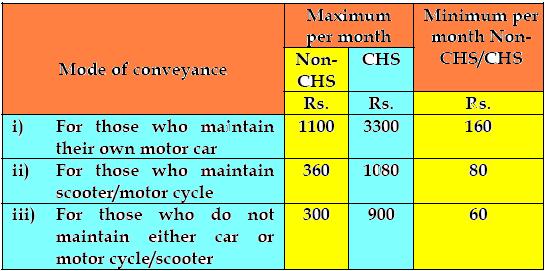
The rates of conveyance allowance payable to doctors have been doubled. These shall henceforth be as given below. One important recommendation is to link this allowance to Consumer Price Index and make the same  subject to annual revision as per he DA formula.

The pay for Junior residents (present scale: 9000 fixed or 9000-9550) and senior residents (present scale: 10325-10975) shall be fixed in pay band 3 (15600-39100) with grade pay of Rs.5400 and 6100 respectively . Benefits proposed for doctors  have also been recommended  to dental surgeons.

NPA payable to doctors is already discussed in the post on other allowances on this blog. Sixth CPC has rejected the demand made by Para Medics for simsilar allowance.


Sixth CPC Report (xiii):Engineering and Scientific Services

Chapter 3.4 of the CPC report deals with Engineering Services which are spread over several Ministries and hence the service conditions vary from one end of the spectrum to other. While considering the case of Engineering Services the Commission has noted that the demand pertaining to better accessibility to higher posts is substantially settled if the recommendations made in other chapters for opening of higher posts to officers from all services is accepted. Therefore any new recommendations have not been made in that regard.

Report has also not agreed to the demand for payment non practicing allowance (NPA) to engineers on pattern of medical services as well as the demand for field duty allowance on the ground that such demands have not been accepted for other services also. However a concession has been made in the rates of Designing and Planning Allowances payable to Engineers in Designing and Planning Wing. It has recommended for 100% increase in these allowances.

Some crucial recommendations pertain to Subordinate Engineering Services. For the posts open to diploma holders in direct recruitment, for members of subordinate engineering services (who were granted minimum pay scale of Rs.5000-8000 by the Vth CPC ) the VIth CPC has recommended PB-2 of Rs.8700-34800 with grade pay of Rs.4200/-. The grade pay admissible to posts where the direct recruitment prescribes qualification of degree in open recruitment the recommended grade pay is Rs.4600/- .  It is expected that this arrangement would settle certain cases where benefits of recommendations of Vth CPC were somehow not given. The above two cadres would provide feeder cadres for the PB-3 which corresponds to the entry grade posts corresponding to Group A services.

The Commission has not agreed to the demand for change in hierarchal structure of the Engineering cadres (on CPWD pattern) on the ground that the scheme for ACP recommended  in report will ensure mobility to higher pay bands on a continuous basis. The recommendations also include suggestion for abolishing the system of separate quotas in promotion posts for degree and diploma holders in future, since this has been found to be  creating imbalances in certain cases.

Scientific Services have been considered in course of discussions for respective Ministries. In Chapter 3.5 detailed discussions have been confined to Flexible Complementing Scheme (FCS) for Scientific Services . This scheme initially confined to certain Ministries and autonomous bodies carrying out research and developmental activities for persons with meritorious abilities provided for assured time bound upward mobility to distinguished scientists . Vth CPC had modified the Scheme and restricted it to Gr.A Scientific services in R&D organizations and excluded personnel posted in Secretariats of the Ministries. It had also laid down a comprehensive and fair mechanism for evaluation of personnel before promotion besides recommending certain residency period prior to promotion. These recommendations were accepted by the Govt. with several modifications and not extended to certain key scientific Departments.

The VIth CPC has recommended for continuation of existing scheme for FCS with the exception of Deptt. Of Atomic Energy, Space and DRDO where merit based promotion schemes in vogue may continue. It seeks to streamline the system of identifying genuine scientific organizations engaged in R&D activities and evolving of new technologies  for coverage under the scheme. The upper limit for promotion is recommended to grade pay of Rs.9000/-. However in case of Deptt. Of Atomic Energy, Space and DRDO it is fixed up to grade pay of Rs.11000/-. The performance assessments boards should be objective and independent comprising of majority of outsiders.

For scientists of proven merit the Commission wants the Departments to have sufficient autonomy in pay fixation and merit being given due weightage. It has suggested that contractual appointments for 3-5 years with option of joining regular Govt. Service may be offered at the time of renewal of contract. The Scheme of Performance based incentives should also be applicable in above mentioned cases.

IPL DLF T20:Chennai Super Kings March into finals

The tame surrender of Delhi Daredevils in their semi final encounter with Shane Warne’s Rajasthan Royals team ensured that the final of IPL DLF T20 tourney would be a battle between the Royals and a king’s taem –either the Chennai Super Kings or King’s XI Punjab. But the 2nd semi final between the two teams with claims to Kingdom on Saturday evening was hardly the battle royale which one had expected . The CSK marched into finals rather effortlessly without any anxious moments.

King’s XI won the toss and decided to bat .The first ball of the match was posted to boundary   and the audience anticipated a thrilling encounter. The excitement was however short-   lived .Kings XI batsmen , soon started a march back to the pavilion with six wickets down for   45 .While Preity Zinta’s cheerful face slowly lost the smile as Yuvi returned to pavillion out for   3 caught by M’Daran of Gony there was a feeble sign of fightback till the seventh wicket was down for 63. The Maratha warrior Powar then took charge of the proceedings for the Punjab King .The highest partnership of the innings yielding 35 runs came off the bats of Mota and Pawar . Powar’s 28 off 21 balls which included one 6 and four boundaries was highest for the side. Lustily hitting round the wicket with a six and two fours of consecutive balls he helped the team to reach certain respectability at 112/8. Only two batsmen could get to double figures.

The bowling honours were shared between Natini, Morkel and Gony with two wickets each. M’Daran getting the wicket of Chawla. Irfan Pathan was run out when he failed to back up after an abortive run. The most economical bowling figures being that of Gony 2/14.

Set up the target of 113 runs CSK opened in stylish fashion with Parthiv and Vidyut who electrified the proceedings with 14 runs coming of the two opening overs from Irfan & Srisanth. In middle of     3rd over Vidyut parted ways with Parthiv returning to pavilion. Thereafter the Chennai     Jauggernaut rolled on effortlessly . The fifty came off 8 overs with the solitary loss of wicket.     Raina hit a brilliant six off Yuvi to push up the run rate. Midway down the street the CSK were     cruising at 66 at the end of tenth over.  While Sreesanth, Powar and Irfan sweated it out, Rain     and Patel continued regular hits to the boundary. After Raina ‘s massive six off Irfan 100 of the innings came in the 14th over and nothing much was thereafter left to be done. Patel reached his second fifty of the tournament shortly.I t was the last boundary from Raina in the next over which sealed the match in favour of CSK. The partnership between him and Patel for the 2nd wicket  yielding 102 runs.

While Raina with 58 runs  was the best bat for Dhoni’s side, Irfan was the lone wicket taker for the bowling side with most economical figures (24 runs in 4 overs).CSK won with 9 wkts and five overs to spare.

IPL DLF T 20:The highs and the lows of the tournament

IPL DLF League T 20 tournment will be at last reaching the last four stage with completion of 56 matches in next week. The league matches saw ups and downs in fortunes of teams and the men who gallantly fought for the respective sides .The march up to the semis has not been without some controversies as well as some hilarious developments. The first controversy interestingly related to a non sport event. The cheer girls from foreign soil hired at a huge cost were the first target of criticism for the outfits which some found against our cultural heritage. To add to their sorrow a famous film star dubbed them as “nachaniya” (dance babes). The girls however hardly lost any cheers and adorned some extra covers to their eye catching costumes to silence their critics.
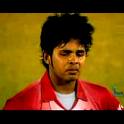

A more eye catching incident followed in shape of teary eyed Sreesanth caught on camera. We learnt that the eye flue like condition was in fact the after effect of Harbhajan Singh’s slapping of young paceman after a match which his team Mumbi Indians lost to Sreesanth’s team. The slap cost Bhajji a five match ban and loss of match fees in approximation of Rs.2.5 Crs.

While the tournament was still recovering from the slap effect and baby Sreesanth’s tears had started drying up , the media started another whisper campaign about emotional response of a team franchisee about selective hugging of good performers based on their nativity. The allegedly class based welcome invited sarcastic responses. The bewildered franchisee thereafter had to contend the team members with a toned down welcome note on return to pavilion after a good knock.

And then came the booze baron’s bombshell. Vijay Mallya the franchisee of Royal Challengers a consistently losing team openly challenged the management potential of his CEO Charu Sharma and blamed him and captain Rahul Dravid for having instigated him into buying a vintage collection of players which turned out to be without any fizz. His choice of the second costliest team, appeared to be chasing victory like the elusive kingfisher as the team remained at second lowest place in the standing on match points. A volley of protests followed .

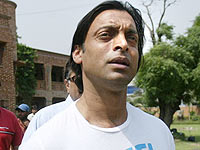
As the dust and din was settling, another dusty rider arrived in shape of Shohaib Akhtar the banned but bailed Pakistan pacer. While everyone thought as to why the guy was sweating so much, some Paki newspapers planted a story of 36 syringes allegedly seized by custom authorities from his bag. While the charge was not found to be correct yet it ushered in dope tests which were to be done randomly. Knight riders then found themselves mired in a controversy spun around their franchisee Shahrukh Khan’s mixing too much with his bunch of knight riders. When anti corruption staff (??) checked his intrusions in player’s area King Khan aggressively protested and also dispatched (leaked to media) an adieu SMS to his team announcing his withdrawal from the playfield till “he learnt rules of the game ” (completed bollywood commitments ???) . The organizers had to come down with systematization of the process. But by that time Dada’s gang already appeared to be riding into the sunset notwithstanding the support from the faulty and fading lighting system at Eden Gardens.
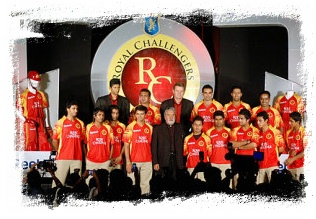
(With Thanks to IPL site for the Pics)

The T20 brand -elusive for Dr. Vijay Mallya

The recent entry of liquor baron Vijay Mallya in the field of Cricktainment known as DLF IPL League has generated some comic confusion, an activity which has been the hall mark of Mallya’s style of functioning. The business tycoon whose name figures two steps ahead of the magical figure of 666 in the Forbes list of billionaires is known for his eat drink and enjoy lifestyle (if you can afford it). Having inherited a conglomerate of motley companies at the age of 28 years Mallya’s fortunes climbed steeply in course of next two decade to make him owner of some of the most sought after territories in liquor trade. But it has also brought in public domain his confusing and contradictory approach to issues of consequence.

Dr. (?) Mallya true to his spend thrift image purchased ( or assembled) the second costliest team ($111.6 millions) of Indian cricketers in the IPL T20 tournament. The Ragged Mallya Challenge It seems that the business baron who proudly acclaims (when you board the Kingfisher aircraft and switch on the mini TV set) that every airhostess in his Kingfisher Airlines has been personally selected by him to treat the passengers as his personal guests was a bit indiscreet this time since his golden team did not display similar devotion to the cause of it’s master and seems to be gravitating towards the bottom of the pit under it’s weight . Mallya reacted promptly and sacked Charu Sharma “CEO” of the team- a commentator whose adornment with this corporate style assignment was decision of Vijay Bhai himself. Dr. Mallya as expected is trying salvage some part of his reputation as producer of world famous liquor brands and breeder of winner race horses with the information that he had left the selection to Chru and Rahul Dravid who selected a test team instead of a team suited for the abbreviated version of the game. Later when another team member Anil Kumble came out in defence of captain Rahul Dravid, Mallya further backtracked and came out to defend team coach.The team despite the changes and fire fighting efforts continues to loose.

Mallya watchers would however contest his contention and recall that he is a man who is inconsistent even while reporting his family roots .While the Wilkipedia reports his place of birth as some obscure town in Karnataka and Calcutta as his place of education, Mallya in an interview to journo Anjali Rao given at his Kingfisher Villa (is it not encroaching on Coastal Regulatory Zone ???) at Goa keenly painted himself as a Goan apparently to reinforce his colorful image. Mallya hardly known for any philanthropic projects, once reported to have spent Rs.1.5 Crs. to purchase a sword belonging to Karnataka warrior king Tipu Sultan in a Sotheby auction at London , for restoring the sword to the motherland. However strangely his wife and family contrary to his patriotic leanings remain ensconced in USA as their home place . About the doctorate which adorns his name, there are apprehensions that it is from a disputed source.

While the blogs promoted by his group rightly praise his genius as a business man , there is a only a subdued reference to his disastrous performance at another sunken ship -the long forgotten Janata Dal of which Mallya is president apparently even now. Having taken over the mantle of Janata Dal President from Subramaniam Swami in the year 2003 he fielded candidates for 20 (unlucky no. for him?) seats for Karntaka Assembly elections. Unfortunately his choice of candidates at that time was total failure since every one from his party lost.

What Dr. Mallya perhaps needs to understand is that while the selection of horses , hostesses and hot calendar models can be made on visual appreciation of certain features , selection of a sports team or political representatives for an election campaign requires tactical skills and intellectual proficiency of a different nature. There are other investors also whose teams are not that successful but they are not complaining because a good businessman should also have a good shock absorption mechanism and in difficult times should wait for the tide to turn.

Quitting the govt jobs :Is the grass really pale on this side

A few days back I came across a very beautiful post in Blogbharati on choice of civil services as a profession, articulating the reasons which make the services a continuing source of attraction for so many young men and women. Not long back there was another interesting article in a leading magazine on a similar subject which on the contrary indicated that a number of former civil servants were moving over to jobs in private sector since they found such jobs much more attractive and satisfying . The former civil servants now stylishly photographed in their Corporate environment were at pains to explain as to how they were now able to give output which was several times higher than what they could deliver in their previous assignments, which they found to be suffocating ( and managed to survive in the suffocation for several decades !). The two conflicting pictures need to be looked into carefully in order to ascertain as to which of the two is closer to reality.

One important information which one could make out from the article on exodus of civil servants was that the number of such senior officers was in the range of not more than two dozen in a year. Out of the massive strength of civil servants in various government jobs the departure of a handful of senior functionaries in a year hardly merits the type of sensational and glossy coverage which the media bestowed on these ex bureaucrats. Was it an impromptu attention of some serious journalist to this issue (which has little relevance or interest for majority of the readers) of social behaviour or something akin to behaviour of IPL cheer girls (who are paid for show of excitement irrespective of the stature or parentage of the players involved) will remain an issue to be pondered with.

Another important issue which calls for attention is whether the process for selection of these senior civil servants to private sector jobs was transparent and open to all others with similar experience and seniority. No doubt these civil servants while holding senior posts must have ensured that all recruitments to public services under respective departments were made through fair and transparent process .Can they say with certainity that their own exodus from civil services was preceeded by a similar exercise, or the selection process merely zeroed down on an officer who was earlier accquaintance of a corporate entity or business house.

Also, the information that substantial number of such bureaucrats were absorbed in infrastructure related companies , for which the ability to closely network with reltaed agencies including govt departments is a key job requirement , makes the situation a bit complex. Further if the challenges and opportunities to perform in Govt service are so limited and poor then what could make these officers who spent a lifetime in such inconsequential jobs , so valuable in the estimation of their new employers ? Is it their professional competence or their proximity to bureaucratic circles which constitute their ESP in the eyes of private sector employers ?

Perhaps these are uncomfortable questions which the ex bureaucrats would find unjustified on the ground that it is their personal life and career and others do not have a right to suspect their abilities or the compelling needs which prompted their new employer to call them to their service. Questions of this nature may also be considered as reflective of frustration on part of those who could not make to the Al dorado.

As civilized civil servants others may accept this argument in honour of departed senior colleagues. But one request that can be made to them is to not to belittle the civil services or present a gory picture of the scenario in order to justify their departure.

They know it well that the scenario is not as bleak , if we take into consideration the fact that we are still a nascent democracy and various social forces are still to come to a state of stable equilibrium in our management set up . The challenges before the administrators are complex, involving human beings and behavioral patterns with various conflicts within them. The country is struggling with modern administrative concepts like e governance and it will be some time before fruits of modern technology will be suitably harnessed to make the life better for common man.

We are ahead of many other countries but still have a long way to go. Till then we need pooled efforts of young and old in the civil, police and allied services to contribute in what ever humble way they can within this complex and sometimes oppressive structure. For every deserter there are thousands who know this truth and feel proud of their jobs. They may be allowed to continue without distraction and interference because the country needs their services.

Sixth CPC:Is the controversy over supremacy of IAS relevant

Before and After the release of various reports of pay commissions, the responses in the society follow a set pattern. Initially there is a dreamy atmosphere in anticipation of benefits . All those who are connected  to  Govt.  sector directly or indirectly relish the predawn signs on the horizon (news leaks on anticipated increase in pay) anticipating that their lives are henceforth going to be dfferent and a royal future awaits round the turn.

Their happiness is however short lived. There are a number of dependent sectors lead by owners of private educational institutions and stretching up-to the presswalla in the back lane who  swoop upon the respective consumers in the entire society and start demanding respective pounds of flesh (sometimes at rates which are quite disproportionate to expected gains) without the flow of benefits having started and without any consideration of the fact as to whether the target group is going to benefit from any pay increase for Govt. Servants. The state of dreaming starts giving way to a state of uncertainty.

Thereafter the  Press and TV follow  up with insulting and insinuating headlines. All civil servants acquire the image of fat and lazy Babus comparable to a gang of bandits who are out to suck the life blood of economy. Screaming headlines announce doubling of pay packets for these suckers. Although the pay hike is for several other categories like armed forces, doctors ,engineers,nurses and technicians but it is the bureaucrat whose obese pictures adorn the covers of magazines as guzzler of currency notes. Dreams turn into despair when benefits are actually calculated and the jump in pay is found to be quite less than anticipated.

Another oft repeated scenario is that of berating the IAS for having again retained it’s so called supremacy over other services. The service is projected in a dim light as unpatriotic for having deprived even the uniformed forces  the  reward of supremacy, ignoring  their courageous performance against heavy odds. Media also reports on ( only a handful of ) cases of resignation from other services out of disgust (which may in fact be due to better retirement benefits offered by the pay commission). Although the various pay commissions despite reiterating the unique position of IAS  have given ample financial benefits across the board to all categories including Army and professionals yet the news reports highlight only the so called favoritism shown to IAS.

The question which comes to mind is whether the controversy is at all relevant. In six decades of it’s life span the Indian democracy has faced challenges of insurgency, natural calamities and elections  with combined efforts of IAS, IPS, Army and professionals with dedication and single minded determination. Issues like who is superior to whom have never clouded the visions of the courageous men representing various organs of State at times of need .

While engaged in task of day to day governance the Government does need a nodal agency to coordinate efforts of various agencies and at that stage the generalist service whether IAS or State Civil Service has to shoulder the responsibility due to it’s outreach, linkage and  exposure over various fields. But this does not imply that these services assume the  role  of tyrant or dictator or the other services resent their so called superiority. Experience has shown that contrary to the media projections  officer in various services do have a healthy feeling of mutual respect for other services and who is above whom is not a  issue of long term significance.


Sixth CPC Report (xii):Retirement benefits for civilian employees

The subject matter concerning more than 38 lakh pensioners ( Defence 19.4 Lakhs, Railways 10.18 Lakhs & Civilians 5.83 Lakhs) with financial liability at current rates being Rs. 30000 Crs. has been dealt with in Chapter 5 of the Sixth Central Pay Commission (CPC) Report. Contrary to expectations the Pay Commission has not suggested any change in the retirement age which would remain at 60 years.The recommendations also do not affect the employees having joined after 1/1/2004 since they are covered under the New Pension Scheme. The said scheme is also flexible in the sense that an employee can assure for himself higher retirement benefits by making contribution at higher rates and hence any additional benefits to the members of the new scheme were not found due.

Regarding the quantum of benefit ( Para 5.1.32) the recommendation is for retention of the existing formula of calculating pension as 50% of the average emoluments. However the Commission has felt that the existing system of payment of full pension only after completion of 33 years of service needs to be changed , since under this system an employee wishing to switch over to alternative employment continues to hang on to Government job merely for the purpose of ensuring full pension on retirement . It has suggested that an employee having rendered qualifying service of 20 years should be entitled to full pension . The pension should be fixed @ 50% of the average pay for last ten months or the last pay drawn whichever is higher.

For the existing pensioners the CPC has proposed additional pension being added  @ 20% of the basic pension on attainment of  age of 80, 85,90, 95 and 100 years.

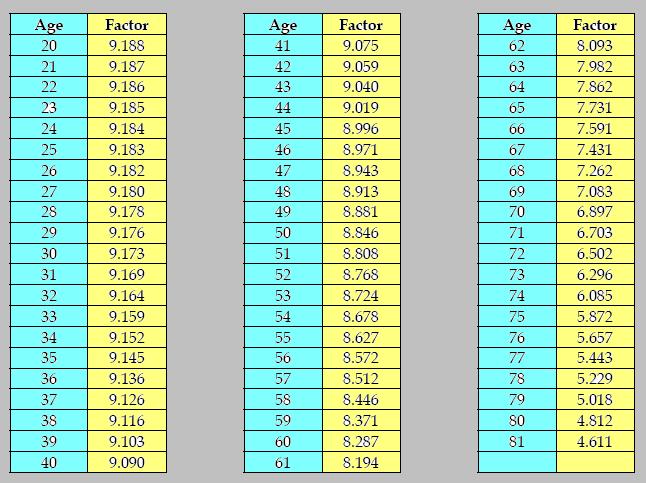
For payment of commutation amount the Commission has noted that various factors suggest that the procedure of restoration of commuted amount after 15 years appears to be more than fair. However the Commission has recommended the a new table (Annex.5.1.2) for calculation of commutation values.

Commutation Table

                                                            (New Commutation Table)

It has also suggested that the business of commutation be passed on to PSU Banks/ Institutions as a routine financial activity. Commission has also suggested periodical review of commutation formula based on market interest rates and mortality rates.

For payment of gratuity the recommendation is for raising of pecuniary limit of Rs. 3.5 Lakhs to Rs. 10 Lakhs.

For leave encashment the recommendation is for allowing encashment of half pay leave (HPL) @ 50% of admissible leave salary also without any consequent reduction in pensionary benefits. However overall combined ceiling of 300 days for encashment of Earned Leave  & HPL shall continue.

For family pension formula any changes have not been suggested except for the recommendation that the pension at enhanced rate would be paid for 10 yrs. (instead of 7 Yrs. for others) in respect of employees dying in harness. The admissibility ceiling of 25 years of age for unmarried daughters has already been removed. Further for medical benefit in respect of family pensioners the dependent children of widowed/ unmarried daughter shall be considered as part of family. The widowed daughter would also enjoy primacy of first category for benefit of family pension. Another major change suggested is that a childless widow shall continue to receive family pension even after her remarriage till her income from all sources exceeds the minimum pension payable in Central Govt.. This progressive gesture has been made to remove the factors which act as impediment in remarriage of such widows.

For cases of employees having accquired (100%) disability a provision has been made for payment of salary for constant attendant on pattern of Army Pensioners.

Amount of Ex gratia payable in case of accident in course of performance of duty has been doubled to Rs. 10 Lakhs and to Rs.15 Lakhs when the casualty is in an International war or due to natural disaster/acts of terrorism in a hard posting area.

The fitment benefit offered to existing pensioners would be 40% of the pension after excluding the merged portion of 50% dearness relief/dearness allowance . In the Table contained in Annexure 5.1.1 details of fitment benefit are available.

Later:The  Finance Ministry have notified the recommendations for Pensioners as accepted by the Govt. along-with the details of conversion table. Click here for accessing the same,

Next Post: Is the debate over  supremacy of IAS justified or of any relevance ?